How Charitable Contribution Deductions Are Changed For 2026
The One Big Beautiful Bill Act made significant changes in the tax benefits of charitable giving.
The changes take effect in 2026 and should be considered in both long-term and short-term charitable giving.
The changes increase charitable gift tax benefits for some taxpayers and reduce tax benefits for other taxpayers.
Also, provisions in the tax law that don’t directly affect charitable gifts have effects that need to be considered when planning donations, if you want to maximize tax benefits.
Let’s start with estate taxes. There’s still an unlimited deduction from the estate tax for charitable gifts.
But the lifetime estate and gift tax exemption was increased to $15 million in 2026 and will be indexed for inflation after that. Estimates are that less than 0.25% of estates will pay any estate tax. That means charitable bequests made through a will provide no tax benefits to most people.
That’s fine when your goal is to retain as much of your wealth during your lifetime as you can and leave a portion of whatever is left to charity through your estate.
But making lifetime charitable gifts can create some tax benefits from charitable donations. That decreases lifetime income taxes, plus the charities receive the benefit years earlier. Consider making lifetime donations instead of bequests in your will.
The income tax changes in the OBBB are significant. Two changes in the OBBB indirectly affect charitable contribution deductions.
The 2017 tax law doubled the standard deduction and indexed it for inflation. That law also limited the itemized expense deduction for state and local taxes (SALT) to $10,000.
The OBBB extends the increase in the standard deduction. The limit on the SALT deduction is increased for many taxpayers but has a cap of up to $40,000 that varies with the taxpayer’s income level.
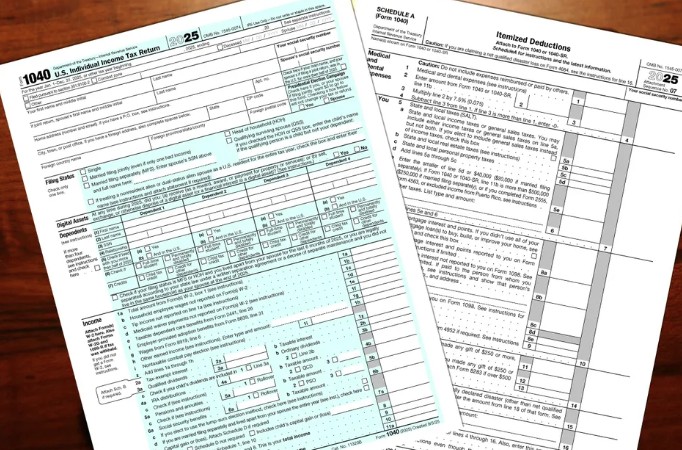
Charitable contributions are deducted as itemized expenses on Schedule A of Form 1040, but only when the total itemized expenses exceed the standard deduction. Since the 2017 tax law, a minority of taxpayers have filed Schedule A. That will continue to be the case, though a few more people will itemize expenses after the OBBB.
To partly offset the effects of those changes, the OBBB created a charitable contribution deduction for taxpayers who don’t file Schedule A, known as an “above the line” deduction.
A married couple filing jointly can deduct up to $2,000 of charitable contributions without filing Schedule A, and unmarried taxpayers can deduct up to $1,000 of donations. This deduction is available beginning with the 2026 tax year.
While that is good news for taxpayers who do not itemize, there is bad news in the OBBB for taxpayers who itemize and make charitable contributions.
The first change is no tax deduction is taken on Schedule A for charitable contributions up to 0.5% of adjusted gross income. Only contributions above that amount are deducted.
When the taxpayer’s adjusted gross income is $200,000, the first $1,000 of charitable contributions (0.5% of $200,000) are not deductible. The new above-the-line deduction isn’t available to those who file Schedule A.
In a few cases, contributions for which deductions are denied because of this rule might be carried forward to future years where they could be deductible.
The denied contributions are carried forward only if in the same tax year the taxpayer exceeded one of the other limits on charitable contribution deductions, such as the rule that limits deductions for cash contributions to 60% of adjusted gross income. Otherwise, there is no carry forward.
Another obstacle faces taxpayers in the top tax bracket. The top income tax rate is 37%. But beginning in 2026, taxpayers in the top bracket receive only the tax benefit for itemized expenses of someone in the 35% tax bracket.
The top tax bracket begins for married couples with taxable income over $768,700 in 2026 and $640,600 for unmarried taxpayers.
If a couple had more than $768,701 of taxable income and $100,000 of charitable contributions itemized expenses in 2025, their income taxes were reduced by $37,000 because of the charitable gifts.
But in 2026 they will not deduct the contributions equal to 0.5% of adjusted gross income and will receive only 35% of the tax benefit of the deduction for the remaining contributions. Their tax benefit will be reduced to $33,655, a loss of $3,345.
A favorable development is the OBBB extended the higher limit on cash contributions to charities that was enacted in 2017. Previously, a taxpayer’s cash charitable contribution deductions for the year couldn’t exceed 50% of adjusted gross income. Contributions that weren’t deductible because of the limit could be carried forward to future years.
The 2017 tax law increased the deduction limit to 60% of adjusted gross income and continued to allow contributions above the limit to be carried forward. The 60% limit was set to expire at the end of 2025. The OBBB extends the 60% limit and the carryforward without expiration dates.
Several charitable tax planning strategies in response to the OBBB are apparent.
Taxpayers who make significant charitable contributions might want to bunch several years of contributions into one year. That ensures they itemize expenses for that year.
Bunching contributions also limits the deductions lost to the 0.5% rule.
A good way to bunch charitable contributions is to contribute to a donor-advised fund. The contributions are deductible in the year they are made to the DAF. But the donor can take time to determine the charitable beneficiaries and spread the contributions over several years. Learn more about DAFs.
The OBBB also makes qualified charitable contributions from traditional IRAs even more valuable. The OBBB didn’t make any changes to QCDs, and contributions made as QCDs avoid the new limits.
I’ve said for years that QCDs are the best way for most people over age 70½ who have traditional IRAs to make charitable contributions. The new rules only increase the benefits of QCDs.